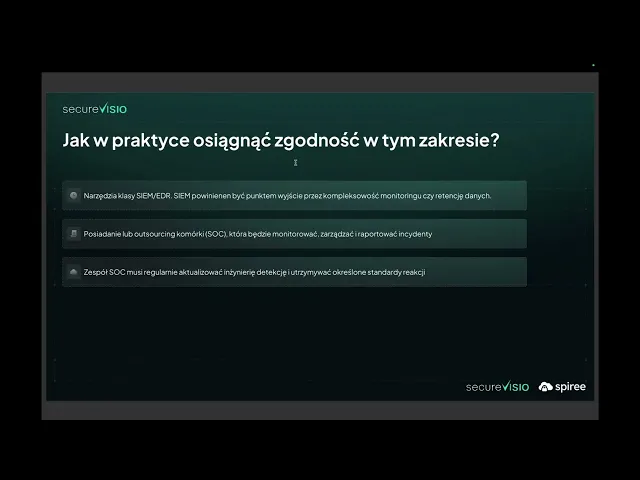
NIS2 and UoKSC in practice: what we learned from the webinar with SecureVisio?
Why Tools Alone Aren't Enough and What NIS2 and UoKSC Compliance Truly Means for Your Organisation
How can you connect regulatory requirements, security operations, and SIEM tools into a single, cohesive operating system?
This was the central question we aimed to answer during our joint webinar with SecureVisio.
It has been two weeks since the event and several days since the new NIS2-related regulations came into force. It is the perfect moment to revisit this topic and summarise the key takeaways – particularly from the perspective of practically implementing these requirements within an organisation.
The webinar recording is available here:
A challenge we see repeating across most organisations. In our conversations with clients, a very similar picture emerges.
Organisations:
are aware of the upcoming obligations under NIS2 and UoKSC,
already possess security tools (e.g., SIEM, SOC, vulnerability scanners),
have started or already prepared a risk analysis.
Despite this, they face one common challenge: these elements are not functioning together as a unified system.
In practice, this means the organisation:
sees incidents but cannot assess their real-world impact,
has a list of vulnerabilities but doesn't know which ones require immediate attention,
has a risk analysis that does not translate into daily operational decisions.
What NIS2 and UoKSC Actually Require
From a regulatory standpoint, the requirements are relatively clear. Organisations are expected to:
manage incidents,
maintain continuous environment monitoring,
gather vulnerability data and respond to it,
conduct risk analyses,
implement technical and organisational measures.
At the same time, the legislation does not define in detail how these elements should be executed in day-to-day operations.
While this leaves room for flexibility, it also builds the greatest challenge: translating regulatory requirements into a living, breathing operational model.
The Biggest Takeaway from the Webinar
Compliance with NIS2 and UoKSC isn't about deploying a tool or preparing documentation.
It is about building a cohesive operating system for your organisation.
In practice, this means connecting three core pillars:
Technology
Platforms like SecureVisio play a foundational role in security operations. They enable:
data collection and correlation,
incident detection,
SOC team support,
response automation,
vulnerability management.
This is the level where the organisation gains visibility into events.
Business Context and Risk Analysis
This element often formally exists on paper but is rarely utilised operationally.
Yet, it is the risk analysis that should answer crucial questions:
which systems and services are critical,
which incidents have a real impact on the business,
which vulnerabilities require immediate remediation.
Without this, it is difficult to talk about making informed decisions.
Operational Model
The third pillar is how the organisation actually operates:
who makes the decisions,
how incident handling is managed,
how communication flows,
how data from systems is translated into actions.
This is the element that ties everything together and determines overall effectiveness.
A Real-World Example
We frequently encounter a similar scenario in many organisations.
A company has:
an implemented SIEM,
vulnerability reports,
security documentation.
Yet, when an incident occurs, fundamental pain points arise:
a lack of clear severity assessment,
ambiguity around decision-making ownership,
delayed response times.
This does not stem from a lack of tools, but rather from a lack of integration between them and the absence of a unified operational workflow.
The Role of Tools in the Context of Compliance
It is worth highlighting that tools like SecureVisio cover a major portion of the requirements stemming from regulations.
They provide:
continuous monitoring,
incident handling,
event correlation,
security operations support.
However, true compliance begins when the organisation can translate that system data into sound business decisions.
What's Next?
The webinar was our first joint event in this format. It allowed us to gather concrete insights and identify areas that require even more clarity.
In our next session, we want to focus even more heavily on practical execution.
Specifically on:
what actual incident handling looks like inside an organisation,
what decisions are made and at what point,
how SIEM system data is leveraged in the daily work of teams.
In other words – less about requirements, and more about how organisations operate when they treat cybersecurity as a live process rather than just a checklist of obligations.
Summary
The core message is simple:
Compliance with NIS2 and UoKSC is not about owning tools or having documents in a folder.
It is about whether your organisation is able to:
understand its risk,
correctly interpret security events,
and make decisions at the right moment.
Only by linking technology, business context, and your operational model can you truly achieve this goal.